Generic classes
This article is a draft
Generic classes are classes that can be parameterized by one or more types.
The most notable examples of generic classes you've seen are probably
list and dict: you can write list[int] no denote a list with just integers,
and you can write dict[str, int] to denote a dictionary where the keys are
strings and the values are integers.
This parameterization is not reserved for built-in types: you and the libraries you use can define their own classes with parameters. This chapter teaches you how to do that.
You might already have an intuition as to why configuring a class with
another type is useful.
Imagine for a moment that the list class does not accept parameters and
can only be used as is in type annotations:
numbers = [1, 2, 3]
reveal_type(numbers)  # list

first = numbers[0]
reveal_type(first)  # what is this? `object`? `Any`?

first + 42  # is this allowed? why?
len(first)  # is this allowed? why?
A lot of programming is concerned with processing collections.
Either accessing the elements of a collection would not really be type checked
(since elements would be inferred as Any or something similar);
or accessing the elements of a collection would require extra conditionals,
leading to very silly code that checks if e.g. first is an int here.
This would be such a bad experience that adding type annotations to code would
rarely be worth the hassle.
Basic syntax
To make a class generic, add square brackets after the class name and list one or more names that will acts as type parameters.
Naming type parameters
For collections and iterators (like list, dict, set,
collections.ChainMap, classes from itertools), and in other cases where
the subject matter is very abstract, it is common to use one-letter names for
type variables, like T; T, U, V; A, B; K, V (for "key" and "value").
However, if you can think of a better name, use that instead. It will help with understanding their purpose when reading the code.
Just like in generic functions (see Chapter 3), you can then use the type parameters in type annotations.
Here, we created a Box class that accepts one type parameter, representing
the type of the value it's storing.
Then, on line 11, we created an instance of Box[int].
You can think of Box[int] as a copy-pasted version of Box where
every instance T is replaced by an int:
class IntBox:
    def __init__(self, value: int) -> None:
        self._value = value

    def put(self, new_value: int) -> None:
        self._value = new_value

    def get(self) -> int:
        return self._value
Instantiating a generic class
You don't have to call the generic class like the above, you can also use a variable annotation:
However, very often you can omit the annotation entirely, ifT can be inferred from
the arguments to __init__:
Use this where possible.
Do not add annotations when they are unnecessary.
You've already seen a common case where this is not an option though — when creating an empty collection:
One reason to avoid the former style is that it has a runtime cost 1.More examples
Pair
An example with more than one type variable:
class Pair[L, R]:
    def __init__(self, left: L, right: R, /) -> None:
        self._left = left
        self._right = right

    @property
    def left(self) -> L:
        return self._left

    @property
    def right(self) -> R:
        return self._right


pair = Pair("red", 42)
reveal_type(pair)        # Pair[str, int]
reveal_type(pair.left)   # str
reveal_type(pair.right)  # int
You can also add an explicit annotation where the type can be inferred, but it's not the type you wanted:
from typing import Literal

type Color = Literal["red", "blue"]

pair2: Pair[Color, int] = Pair("red", 42)
pair3: Pair[str, list[int]] = Pair("red", [True, True, False])
Stack
from collections.abc import Iterable, Iterator
from typing import reveal_type

class Stack[T]:
    def __init__(self, items: Iterable[T] = (), /) -> None:
        self._items = list(items)

    def __len__(self) -> int:
        return len(self._items)

    def __iter__(self) -> Iterator[T]:
        return iter(self._items)

    def push(self, item: T, /) -> None:
        self._items.append(item)

    def pop(self, /) -> T:
        return self._items.pop()

int_stack = Stack([1, 2, 3])
reveal_type(int_stack)  # `Stack[int]`

stack_idk = Stack()
reveal_type(stack_idk)  # mypy, ty, pyrefly say: `Stack[Any]`
                        # pyright says: `Stack[Never]` (see explanation)

stack_explicit: Stack[int] = Stack()
reveal_type(stack_explicit)  # `Stack[int]`

str_stack = Stack(["a", "b", "c"])
reveal_type(str_stack)        # `Stack[str]`
str_stack.push("something")   # ok
reveal_type(str_stack.pop())  # `str`
str_stack.push(42)            # type checking error
Type checkers don't agree on what to do with stack_idk.
mypy, pyrefly and ty all say that it's Stack[Any] (or something close),
because they don't have any clues as to what T in Iterable[T] stands for.
However, pyright infers it as Stack[Never].
We haven't seen typing.Never before, but it will probably appear in a later chapter.
It is an unusual special type that contains no values at all.
For example, if x: list[Never] then x is always empty.
pyright sees that () is empty, which means that it's a tuple[Never, ...]
and therefore an Iterable[Never], so it solves that T = Never.
Some type checkers have configuration options to catch situations where you
accidentally make a value with a partially unknown type (meaning that it has
Any as a parameter without you explicitly writing it).
mypywill complain thatstack_idkneeds an annotation without any settings- In
pyrefly, enable theimplicit-anyconfiguration option - In
pyrightorbasedpyright, enable thereportUnknownMemberType,reportUnknownVariableTypeand all the other^reportUnknown.*options. Alternative, set thetypeCheckingModetostrict, which changes the defaults to these options.
If you don't want to accept an initial iterable in the __init__, you can explicitly annotate
the attribute in the __init__ or the class body:
class Stack[T]:
    def __init__(self) -> None:
        self._items: list[T] = []
# or:
class Stack[T]:
    _items: list[T]

    def __init__(self) -> None:
        self._items = []
map
from collections.abc import Callable, Iterator, Iterable

class MapIter[Src, Dest]:
    def __init__(self,
        source: Iterable[Src],
        fn: Callable[[Src], Dest],
    /) -> None:
        self._it = iter(source)  # self._it inferred as: Iterator[Src]
        self._fn = fn

    def __iter__(self) -> Iterator[Dest]:# (1)!
        return self

    def __next__(self) -> Dest:
        return self._fn(next(self._it))
typing.Selfmight be more appropriate here, but we haven't introduced it yet, butIterator[Dest]orMapIter[Src, Dest]are perfectly fine.
What's interesting here is that once you instantiate MapIter, none of the
public interface of the class mentions Src.
It only matters inside of the class body: inside of __next__,
self._it is of type Iterator[Src], next(self._it) is of type Src,
and self._fn is of type Callable[[Src], Dst].
TODO: more examples
Difference between method-level and class-level type variables
In Chapter 3's "Generic methods" section we showed an example of a generic method with its own type variable. That's not the same as the whole class being generic. It's crucial to understand the difference.
Let's look at the example from chapter 3:
from collections.abc import Callable, Iterator

class Times:
    def __init__(self, value: int) -> None:
        self._value = value

    def repeat[T](self, item: T, /) -> list[T]:
        return [item] * self._value

    def do[T](self, fn: Callable[[int], T], /) -> Iterator[T]:
        for i in range(self._value):
            yield fn(i)


times = Times(10)
reveal_type(times)  # Times
                    # ^^^^^ no parameter!

strings = times.repeat("banana")
reveal_type(strings)  # list[str]

numbers = times.repeat(42)
reveal_type(numbers)  # list[int]

hundreds = times.do(lambda x: x * 1.5)
reveal_type(hundreds)  # Iterator[float]
The Times class is not generic, you cannot parameterize it.
All of its attributes are also of a non-generic type.
The repeat method is a self-contained generic function,
and the do method is also a self-contained generic function.
They do not have some shared T type when you call those methods on the same instance.
You can also give the type variables different names, and it won't change the behavior:
class Times:
    def __init__(self, value: int) -> None:
        self._value = value

    def repeat[T](self, item: T, /) -> list[T]:
        return [item] * self._value

    def do[Ret](self, fn: Callable[[int], Ret], /) -> Iterator[Ret]:
        for i in range(self._value):
            yield fn(i)
To further illustrate the difference, here's a generic class that also has a generic method:
from collections.abc import Iterable, Iterator, Callable

class Stack[T]:
    def __init__(self, items: Iterable[T] = (), /) -> None:
        self._items = list(items)

    def __len__(self) -> int:
        return len(self._items)

    def __iter__(self) -> Iterator[T]:
        return iter(self._items)

    def push(self, item: T, /) -> None:
        self._items.append(item)

    def pop(self, /) -> T:
        return self._items.pop()

    def map[U](self, func: Callable[[T], U], /) -> Stack[U]:
        return Stack(map(func, self._items))

strings = Stack(["apple", "banana", "cherry"])
reveal_type(strings)  # Stack[str]

lengths = strings.map(len)
reveal_type(lengths)  # Stack[int]

encoded = strings.map(lambda s: s.encode())
reveal_type(encoded)  # Stack[bytes]

first_letters = strings.map(lambda s: s[:1])
reveal_type(first_letters)  # Stack[str]
Here, the T type variable is scoped at the class level, and the U
type variable is scoped to the map method.
T describes variation that applies to the a particular Stack instance, while
U describes variation that applies to a particular call of Stack.map.
Inheriting from a generic class
There are three scenarios you can encounter when inheriting from a generic class, depending on what your goals are.
Scenario 1: inheriting to create a new generic class
class ClearableStack[A](Stack[A]):
    def clear(self) -> None:
        self._items.clear()

    def pop_all(self) -> list[A]:
        old_items = self._items
        self._items = []
        return old_items
Here, we create a new generic class called ClearableStack parameterized by A,
and it inherits from Stack[A].
It will inherit all the attributes and methods of the parent class as you'd expect:
if stack: ClearableStack[int], then iter(stack) will be an Iterator[int], and
stack.pop() will be an int.
Scenario 2: inheriting to create a new concrete class
In this example, we create a new StringStack class which is not generic, since it
does not have any type parameters.
StringStack inherits from Stack, filling in its type parameter with a concrete str.
For an example in the standard library, see the built-in range class:
why is range a sequence?
If you didn't already know, range is a numeric sequence class that you can
slice and index:
Here's a more interesting example from the multidict library:
In this case, MutableMultiMapping is generic, but only with one parameter
for the value type.
It inherits from MutableMapping[str, V], fixing the key type as str.
One thing to look out for: if you inherit from a generic class without
parameterizing it, you will be implicitly inheriting from that class
parameterized by Any.
# wrong! (CoolList is not generic; inherits from list[Any])
class CoolList(list):
    ...

# also wrong! (CoolList[T] inherits from list[Any])
class CoolList[T](list):
    ...

things = CoolList([1, 2, 3])
x = things[0]  # x is inferred as `Any`
Here, CoolList inherits from list[Any], so this is "Scenario 2" while you
probably meant to use "Scenario 1" and make CoolList generic:
To prevent this mistake, you can enable the reportMissingTypeArgument diagnostic
in Pyright or use --strict with mypy.
Scenario 3: inheriting with transformed parameters
This is the most complex way to inherit from a generic class, where the child class is also generic, but the parent parameters and child parameters don't match 1-to-1:
class NestedStack[T](Stack[Stack[T]]):
    def pop_inner(self) -> T:
        while self._items:
            if self._items[-1]:
                return self._items[-1].pop()
            else:
                self.pop()
        raise ValueError("No more items")

xs = NestedStack([Stack([1, 2]), Stack([3, 4]), Stack([5])])
# `xs` is a `NestedStack[int]`, and also a `Stack[Stack[int]]`.

x = xs.pop()  # `x` is a `Stack[int]`
y = xs.pop_inner()  # `y` is an `int`
For an example from the real world, take a look at the classes in
networkx.classes.coreviews:
Variance of generic classes
In Chapter 4 we introduced the concepts of assignability and variance, and mentioned some rough rules for figuring out the variance of a class. Now that you know how to define your own generic classes, we'll make it more rigorous.
Recap
As a reminder, variance describes how assignability of a type parameter impacts
the assignability on the generic class as a whole.
Assuming that Banana is assignable to Fruit (perhaps a subclass of Fruit),
Class[T] is:
- covariant if
Class[Banana]is assignable toClass[Fruit] - contravariant if
Class[Fruit]is assignable toClass[Banana] - invariant if neither is true (
Class[Fruit]andClass[Banana]are not assignable to each other)
A covariant class parameterized by T is a pure "producer" of Ts.
It's safe to assign a: Producer[Banana] to b: Producer[Fruit] because
you can only interact with b by getting some Fruit out of it.
And since you should be okay with getting a Banana as part of that, that's okay.
Immutable collections are typically covariant.
![Conveyor belt delivering fruits to a funnel labeled 'Belt[Fruit]',
and a conveyor belt delivering bananas labeled 'Belt[Bananas]' shown as assignable to it,
but not the other way around](covariance_belt_illustration.png)
Belt[T] is covariant in T
A contravariant class parameterized by T is a pure "consumer" of Ts.
It's safe to assign a: Consumer[Fruit] to b: Consumer[Banana] because
the only way to interact with a is to give it Fruits, and Banana is
a kind of fruit, so a must be capable of handling them too.
"Handlers" of things (events, requests, etc.) are typically contravariant.
![Funnel accepting any fruits from a conveyor belt labeled 'Funnel[Fruit]',
and a funnel with a banana-shaped hole and a warning saying 'Banana only!' with type 'Funnel[Banana]'.
The fruit funnel is assignable to the banana funnel, but not the other way around.](contravariance_belt_illustration.png)
Funnel[T] is contravariant in T
An invariant class parameterized by T has ways to interact with it that
get a T from it as well as give it Ts.
Flexing the parameter either way will land you in trouble: if you assign a: Both[Banana]
to b: Both[Fruit], you risk someone handing b an Apple, which it cannot handle;
and if you assign a: Both[Fruit] to b: Both[Banana], you risk b producing something
which is not a banana.
Mutable collections are typically invariant.
![Tank that accepts bananas and produces banana juice on the left labeled 'Tank[Banana]'.
Tank that accepts any fruits and produces multifruit juice on the right labeled 'Tank[Fruit]'.
They are not interchangeable](invariance_belt_illustration.png)
Tank[T] is invariant in T
The algorithm
This is the series of steps you need to take to figure out the variance of a class. It might be a bit complex, but we'll break down the steps in more detail.
-
If there are any public (not
_underscoredor__mangled) attributes inClassthat depend onT, thenClassis invariant inT2. -
Imagine that
Bananais assignable toFruit, but not the other way around. Construct two versions of the class,Class[Banana]andClass[Fruit]. -
Check the compatibility of private attributes. For each attribute
_attr:- If
Class[Fruit]._attris not assignable toClass[Banana]._attr, thenClasscannot be contravariant inT. - If
Class[Banana]._attris not assignable toClass[Fruit]._attr, thenClasscannot be covariant inT.
In other words: if all the attributes are covariant in
T, the class is allowed to be covariant inT; if all the attributes are contravariant inT, the class is allowed to be contravariant inT. - If
-
Check the compatibility of methods:
- If
Class[Fruit].methodwouldn't be compatible withClass[Banana].method, thenClasscannot be contravariant inT. - If
Class[Banana].methodwouldn't be compatible withClass[Fruit].method, thenClasscannot be covariant inT.
child_funcis compatible withparent_funcif, given:def parent_func(self, arg: OriginalArg) -> OriginalReturn: ... def child_func(self, arg: NewArg) -> NewReturn: ...OriginalArgis assignable toNewArgandNewReturnis assignable toOriginalReturn. - If
-
By this point, if both covariance and contravariance are possible, then the class is considered covariant. If neither of them is possible, it is invariant.
This algorithm is phrased in terms of adding restrictions. We start with the assumption that the class can "flex" in both directions (co- and contra-) and we try to "cross out" one of the directions on each step.
If this is confusing, think of it this way: if all the elements are pointing in one direction (e.g.: prohibit contravariance, allowing covariance), then the entire class is "that direction" (e.g.: covariant). If the directions are mixed (sometimes we cross out covariance, sometimes cross out contravariance), then the class is invariant.
First, let's look at methods (step 4).
In Chapter 4, we introduced a shortcut: covariant type variables occur in "output positions" (return types), and contravariant type variables occur in "input positions" (argument types).
Step 4 in the algorithm phrases it more accurately: we check the assignability of argument and return types.
This correctly takes into account cases where argument and return types themselves are generics parameterized by the class's type parameter. In a sense, this plays back recursively into assignability. Let's look at a practical example:
class Belt[T]:
    def get_next(self) -> T: ...
    def on_next(self, callback: Callable[[T], None]) -> None: ...

    def get_many_tuple(self, count: int) -> tuple[T, ...]: ...
    def get_many_list(self, count: int) -> list[T]: ...
-
get_next:Bananais assignable toFruit, and there are no arguments, soBelt[Banana].get_nextis compatible withBelt[Fruit].get_next. But not the other way around:Fruitis not assignable toBanana, soBelt[Fruit].get_nextis not compatible withBelt[Banana].get_next. This meansBeltcan still be covariant, but cannot be contravariant. -
on_next:Belt[Fruit].on_next: (self, callback: Callable[[Fruit], None]) -> Fruit Belt[Banana].on_next: (self, callback: Callable[[Banana], None]) -> BananaRemember,
Callableis contravariant in its parameters, soCallable[[Fruit], None]is assignable toCallable[[Banana], None]. Therefore,Belt[Banana].on_nextis compatible withBelt[Fruit].on_next.As in
get_next:Callable[[Banana], None]is not assignable toCallable[[Fruit], None], so this method would preventBeltfrom being contravariant.This illustrates why "input position" and "output position" are a bit misleading.
Tis used as an input to a contravariant type, so it's used in the "output position" here. -
get_many_tuple:Belt[Fruit].get_many_tuple: (self) -> tuple[Fruit, ...] Belt[Banana].get_many_tuple: (self) -> tuple[Banana, ...]This will be almost the same as in
get_next:tuple[Banana, ...]is assignable totuple[Fruit, ...] (becausetupleis covariant), and there are no arguments, soBelt[Banana].get_nextis compatible withBelt[Fruit].get_next. Not the other way around, so it's not contravariant. -
get_many_list:list[Banana]is not assignable tolist[Fruit], andlist[Fruit]is not assignable tolist[Banana]. Therefore, this method requiresBeltto be invariant.This might be surprising, since you can imagine that the method probably constructs a new a list on the fly, since storing a
list[T]as an attribute would make the class invariant.Here's one way you could violate type expectations if
Beltcould be covariant withget_many_list:bananas: list[Banana] = [Banana(), Banana()] class BananaBelt(Belt[Banana]): def get_many_list(self) -> list[Banana]: return bananas banana_belt = BananaBelt() generic_belt: Belt[Banana] = banana_belt #^ allowed because of direct subclassing fruit_belt: Belt[Fruit] = generic_belt #^ this would be allowed because of covariance fruits: list[Fruit] = fruit_belt.get_many_list() fruits.append(Apple()) # now `bananas` contains an `Apple()`Another example
Here's another example that doesn't involve subclassing
Belt:from collections.abc import Iterable, Callable class CallbackList[T](list[T]): def __init__( self, iterable: Iterable[T] = (), callback: Callable[[T], None] = lambda _: None, /) -> None: self._callback = callback super().__init__(iterable) def append(self, o: T, /) -> None: self._callback(o) super().append(o) class Belt[T]: def __init__(self, item: T) -> None: self._items = (item,) * 100 def get_first(self) -> T: return self._items[0] def get_batch(self) -> list[T]: def callback(item: T) -> None: self._items = (item,) + self._items return CallbackList(self._items, callback) belt1: Belt[int] = Belt(42) belt2: Belt[object] = belt1 #^ this would be allowed with covariance belt2.get_batch().append("a") first: int = belt1.get_first() #^ ...but first is actually a string!
Rule of thumb
If following the algorithm outlined above feels too difficult, you can follow this simple rule of thumb when mentally evaluating a type parameter's variance:
Start at the generic itself, and step-by-step evaluate the type surrounding it with these rules in mind:
- By default, assume the generic is covariant
- When used in a contravariant position, its variance is "swapped" to the other one
- When used in a covariant position, its variance stays the same
- When used in an invariant position, stop here. The generic is invariant!
Let's look at some examples:
from collections.abc import Callable

class A[T]:
    # T is used in a contravariant position - swap from covariant to contravariant
    # verdict: contravariant
    def fn(self, value: T): ...

class B[T]:
    # 1. T is used in a contravariant position (`Callable[[T], None]`) - swap from covariant to contravariant
    # 2. `Callable[[T], None]` is used in a covariant position - don't swap
    # verdict: contravariant
    def fn(self) -> Callable[[T], None]: ...


class C[T]:
    # 1. T is used in a contravariant position (`Callable[[T], None]`) - swap to to contravariant
    # 2. `Callable[[T], None]` is used in a contravariant position again - swap back to covariant
    # verdict: covariant
    def fn(self, fn: Callable[[T], None]): ...

class D[T]:
    # 1. T is used in a contravariant position (`Callable[[T], None]`) - swap to contravariant
    # 2. `Callable[[T], None]` used in a contravariant position (`Callable[[Callable[[T], None]], None]`) - swap back to covariant
    # 3. `Callable[[Callable[[T], None]], None]` used in covariant position - don't swap
    # verdict: covariant
    def fn(self) -> Callable[[Callable[[T], None]], None]: ...

class E[T]:
    # 1. T is used in a contravariant position (`Callable[[T], None]`) - swap to contravariant
    # 2. `Callable[[T], None]` used in a contravariant position (`Callable[[Callable[[T], None]], None]`) - swap back to covariant
    # 3. `Callable[[Callable[[T], None]], None]` used in contravariant position (`Callable[[Callable[[Callable[[T], None]], None]], None]`) - swap again to contravariant
    # 4. `Callable[[Callable[[Callable[[T], None]], None]], None]` used in covariant position - don't swap
    # verdict: contravariant
    def fn(self) -> Callable[[Callable[[Callable[[T], None]], None]], None]: ...
Now let's see some invariant examples:
class F[T]:
    # 1. T is used in an invariant position - stop here
    # verdict: invariant
    def fn(self, value: list[T]): ...

class G[T]:
    # 1. T is used in a contravariant position (`Callable[[T], None]`) - swap to contravariant
    # 2. `Callable[[T], None]` used in an invariant position (`list[Callable[[T], None]]`) - stop here!
    # verdict: invariant
    def fn(self) -> Callable[[Callable[[list[Callable[[T], None]]], None]], None]: ...
Note that once we encounter an invariant position, we don't need to mentally parse the rest of the type, no matter how nested it gets.
When multiple methods are involved, or if the generic is used in multiple places within the same signature, the result will be invariant unless the verdict is the same for each usage. Some more examples:
class H[T]:
    # usage 1: contravariant
    def fn(self) -> Callable[[T], None]: ...

    # usage 2: covariant
    def fn2(self) -> T: ...

    # both covariant and contravariant usages - final verdict: invariant

class I[T]:
    # usage 1: contravariant
    def fn(self) -> Callable[[T], None]: ...

    # usage 2: contravariant
    def fn2(self, value: T) -> None: ...

    # only contravariant usages - final verdict: contravariant


class J[T]:
    # usage 1: covariant
    # usage 2: contravariant
    def fn(self, value: Callable[[T], None]) -> Callable[[T], None]: ...

    # both covariant and contravariant usages - final verdict: invariant
TODO: expand on how attributes impact variance, and the role of private attributes (the current behavior makes no logical sense, so it's kind of a tricky topic)
Why variance?
As you can see, variance is a difficult topic taking up up an entire book chapter. It better actually do something. So what would happen if variance didn't exist?
(if you're already convinced, feel free to skip this)
Why variance
Option A. Everything is invariant
It means that, if you have x: GenericClass[A] and y: GenericClass[B], you can only
assign x = y or y = x if A is exactly the same as B.
So, you cannot assign:
tuple[int, ...]toIterable[int | None]list[int]toIterable[float]list[int]toIterable[object]Callback[AnyEvent]toCallback[SpecificEvent]
You would need to add extra steps (at runtime as well) to e.g. first "convert"
a list[int] to list[object], and only assign that to Iterable[object].
This would be unacceptable from an ergonomics perspective.
It would also be really difficult to explain why you cannot assign list[int] to
Iterable[object].
Just saying that the type parameter is different is not helpful.
Obviosly, a list of integers is an iterable of objects.
Option B. Everything is whatever-variant
I don't understand variance.
Just let me assign list[int] to list[object]!
(and vice versa?)
In TypeScript, variance is very loosey-goosey. For example, mutable arrays are covariant:
type Fruit = { name: string }
type Banana = {
    name: string,
    length: number,
    color: "green" | "yellow" | "brown",
}

function addFruit(fruits: Fruit[]) {
    fruits.push({name: "Apple"})
}

const bananas: Banana[] = []
addFruit(bananas)  // allowed
interface FruitHandler {
    callback(foo: Fruit): void
}
interface BananaHandler {
    callback(foo: Banana): void
}
function f(t: FruitHandler) { g(t) }
function g(t: BananaHandler) { f(t) /* allowed?! */ }

interface FooHandler {
    handle(foo: number, bar: Fruit | null): void
}
interface BarHandler {
    handle(foo: number, bar: Fruit): void
}
function f1(h: FooHandler) { f2(h) }
function f2(h: BarHandler) { f1(h) /* allowed?! */ }

// From https://stackoverflow.com/questions/61775252:
class Result<T> {
    object: T | null = null;
}

function setOnlyA(res: Result<{ a: number }>) {
    res.object = { a: 5 };
}

function setAB(res: Result<{ a: number; b: string }>) {
    setOnlyA(res);  // allowed?!
}
While I understand that this leads to fewer red squiggles in your editor,
I don't this decision in TypeScript.
This undermines the main purpose of TypeScript (or any type system),
which is preventing mistakes in an automated way, even when all of your
code is 100% covered by type annotations and doesn't use any escape hatches
like any or as.
Especially given how much JavaScript will hide the runtime result of
such mishaps, happily adding undefined and null to strings and numbers
for example (unlike Python which will at least raise an exception).
Debugging variance
Here's an example class:
from collections.abc import Sequence

class Box[T]:
    def __init__(self, things: Sequence[T], /) -> None:
        self._things = things

    def count_things(self) -> int:
        return len(self._things)

    def first_thing(self) -> T:
        return self._things[0]

    def copy_things(self) -> list[T]:
        return list(self._things)
Imagine that you're getting an error saying that it's invariant. But you want it to be covariant. How do you figure out what's wrong?
First, to diagnose the issue: if you're using a language server (like pyright or zuban),
you can hover over a type variable and see what its inferred variance is.
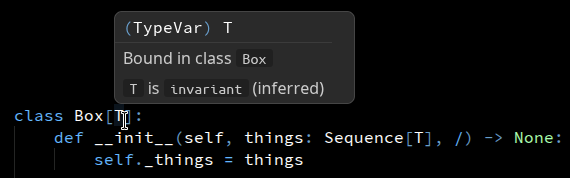
That's handy, but unfortunately it doesn't tell you why T is invariant.
If you already understand variance well, you can usually go over the method
signatures and spot methods which prevent T from being covariant.
But sometimes it's tricky, or maybe you have a lot of complicated signatures.
So what you can do is bisect the class:
- Comment out everything except the
__init__of the class. IfTis still invariant, then the issue must be with the attributes (e.g. if you saved alist[T]as an attribute). - If not, uncomment the top half of the methods.
Is
Tinvariant or contravariant? Then the issue is in the top half of the methods. - If not, uncomment the bottom half of the methods.
Is
Tinvariant or contravariant? Then the issue is in the bottom half of the methods. - Apply steps 2 and 3 to the half in which the problematic method must be.
Is this smart? No. Is there a better way? Also no...
Covariance and @dataclass
Note
See Discourse thread
Before Python 3.13, this class was covariant:
(note the frozen=Екгу: if the attribute was mutable, the class would have to be invariant)
With Python 3.13 and the addition of __replace__,
this class suddenly becomes invariant.
Wut?
Type checkers support dataclasses by "synthesizing" methods that @dataclass defines manually:
@dataclass(frozen=True)
class Labeled[T]:
    value: T
    label: str

    # pretend that this is generated
    def __init__(self, value: T, label: str) -> None: ...
    def __repr__(self) -> str: ...
    def __hash__(self) -> int: ...
__replace__ method would look like this:
if you go through the variance algorithm (or just apply your intuition),
this method does indeed make the class invariant, as T is now in the input position.
To this day, there is no official solution to this.
However, if you're using basedpyright, you can follow
this recipe
to skip synthesizing the __replace__ method:
# pyright: enableBasedFeatures=true

from typing import dataclass_transform
from dataclasses import dataclass


@dataclass_transform(skip_replace=True, frozen_default=True)
def frozen[T: type](t: T) -> T:
    return dataclass(frozen=True, slots=True)(t)


# check that this enables covariance:
@frozen
class Box[T]:
    value: T

box1: Box[str] = Box("test")
box2: Box[str | int] = box1  # no error
Generic classes before Python 3.12
TODO
If you're interested, you can contribute this section.
-
The amount of extra time and the reason for it can be quite surprising. Turns out that both creating
Class[Param1, Param2]and instantiating it is slow:Python 3.14.5 (IPython 9.14.0)In [2]: %timeit defaultdict() 109 ns ± 0.374 ns per loop (mean ± std. dev. of 7 runs, 10,000,000 loops each) In [3]: %timeit defaultdict[set, set[int]]() 653 ns ± 4.85 ns per loop (mean ± std. dev. of 7 runs, 1,000,000 loops each) In [4]: %timeit defaultdict[set, set[int]] 224 ns ± 0.312 ns per loop (mean ± std. dev. of 7 runs, 1,000,000 loops each) In [5]: %timeit defaultdict["set", "set[int]"] 87.8 ns ± 0.497 ns per loop (mean ± std. dev. of 7 runs, 10,000,000 loops each) In [6]: d = defaultdict[set, set[int]] In [7]: %timeit d() 403 ns ± 4.06 ns per loop (mean ± std. dev. of 7 runs, 1,000,000 loops each)Python 3.14.5 (IPython 9.14.0)In [1]: class Custom[T]: pass In [2]: %timeit Custom() 65.9 ns ± 0.0822 ns per loop (mean ± std. dev. of 7 runs, 10,000,000 loops each) In [3]: %timeit Custom[int]() 830 ns ± 2.59 ns per loop (mean ± std. dev. of 7 runs, 1,000,000 loops each) In [4]: %timeit Custom[int] 620 ns ± 5.33 ns per loop (mean ± std. dev. of 7 runs, 1,000,000 loops each) In [5]: d = Custom[int] In [6]: %timeit d() 202 ns ± 0.714 ns per loop (mean ± std. dev. of 7 runs, 10,000,000 loops each)One potential reason instantiating a parameterized class is slow is that it attaches (or attempts to attaches) some extra metadata to the object:
Of course, this is Python, so there's a limit to how paranoid it makes sense to be about achieving optimal performance. But I think it's a good to be aware of how expensive common operations are. ↩
-
This is not quite true. The full truth is something like this:
-
For private attributes,
_attr: Xor__attr: Xis evaluated as if it was a method with a(self) -> Xsignature. -
For public attributes,
attr: Xis evaluated as if it was a pair of methods (or a property) with the signatures(self, arg: X) -> Noneand(self) -> X.
For most cases, this would work the same, but
Anybreaks these rules. Here's an example of an edge case where this is different:from typing import Any class FooAttr[T]: def __init__(self) -> None: self.things: list[T | Any] = [] class FooMethod[T]: def get_things(self) -> list[T | Any]: ... def set_things(self, arg: list[T | Any]): ...In both
FooAttrandFooMethod,list[Fruit | Any]andlist[Banana | Any]are assignable to each other, so the class is allowed to be both covariant and contravariant (as written, it is covariant, since it has no other items). ↩ -